Athletes and the happy hour
This is an entry from my journal. It is about pacing ourselves and maintaining a balance in our life.
There are so many things I have learnt from football in no small part because I was paying close attention the entire time. Your physical and mental states must be in harmony, otherwise you are thrown off balance.
A physically strong person becomes imbalanced easily if they have a short temper, for example. You can disturb them with just a few words. Then they do not have the emotional stability to resume what they were preoccupied with. Governed by uncontrollable anger, they will do something that will come to haunt them later. Over time, this imbalance will be ruinous to their life. As such, their strength does not contribute to their empowerment, at least not to the extent it otherwise could. It becomes a curse, even when it appears to be a blessing.
Same principle for those who have mental fortitude, such as a combination of patience, curiosity, and intelligence, but fail to take care of their body. Eventually they get tired very easily. They can no longer sustain their concentration on a given task. Their brain is foggy and their excitement is snuffed out. What they do becomes sloppy and disconcerted. Their stress levels are high at all times and reach critical levels under duress. They thus find themselves in situations where they feel disoriented, overwhelmed, and defeated.
The gist is that you cannot be in control of yourself in phase one and of yourself in rapidly evolving states of affairs in phase two while mind and body are not cooperating with each other. The imbalance will hinder your potential.
Imbalance can happen to anyone
You are well positioned onlye when there is concordance of mind and body.
Balance of this sort describes the baseline of the person. It is about who they are day-by-day. Yet even a balanced person can be thrown off balance under certain circumstances. A case of force majeure is not only excusable but also the kind of scenario that does not necessarily break one’s resolve. Whereas yielding to the temptation of an easy way out sets in motion a process of moral erosion, of the person’s character gradually disintegrating unless through active intervention, and of them eventually failing to keep up with the rigours in their life.
In quotidian affairs this happens when we start having “cheat days” where we suspend our rules for no principled reason. There is the appeal of immediate gratification which nevertheless comes at the expense of longer-term instability. We think we can bargain with daemons, only to learn that we are puny humans. You cannot have a night of heavy drinking with the lads and expect to be performing at your peak the day after. And, depending on the frequency of such cheat days, you will not be performing well for the entire week and beyond.
Even absent moral degeneracy, imbalance can occur in the wake of mindless application. To use an example from football, you exert yourself to chase after every lost ball even though it is clear you will not reach it. It is passion that drives you, which is a powerful motive for competitiveness and a key contributor to peak performance. Though inconsiderate passion becomes wasteful. You cannot keep chasing lost balls over the course of 90 minutes and still have the tenacity to be involved in every phase of play. It then is important to pace yourself. To know when it is not worth doing something which is otherwise beneficial to you. Let the ball go out of play and conserve energy for when the time is right, such that you affect the match to the maximum of your ability.
If you do not pace yourself, then you will be thrown off balance, in the sense here considered but also literally by being pushed around and outmuscled more easily. Your tank will be depleted earlier and you will be running out of breath. This, in turn, will make your brain more hazy. You will not see clearly. Everything will become a blur as you will not have the attentiveness to discern patterns in your space. You will not estimate correctly how far or near the opponents are. You will not have an accurate model of where your teammates are moving towards. You will not be able to discern the passing lanes and the openings for an opportunity at goal. In short, your body will be sabotaging your mind because your mind, by allowing an excess of needless action, created conditions for the body to fail in. Such is a vicious cycle of discord between mind and body that will make you lose control of the situation.
Pacing oneself for the long-term
Balance over time is thus a matter of pacing. You cannot sprint your way to a marathon run. The only way to do it is by committing to a relatively slow and steady pace. Even then, you have to make that your normality for a long time, such that your overall life is one of slow and steady experiences. You cannot be impatient and also work towards becoming a competent marathon runner. It will not work, because the moment you are on the road, your impatience will compel you to give up and to then shift your attention to whatever your immediate desire is. Competence in running involves skilfulness in taking it slow, and the other way round, which are both developed one tiny step at a time.
The athlete gives us a model of the person who enjoys gratification over the long-term. There still are the moment-by-moment ups and down, but the trajectory is one of controlled satisfaction, of vigour within constraints. It is not extreme and so it does not oscillate from the zenith to the nadir. It consists in a state of moderation between the notional extremes.
One does not need to be an athlete to appreciate the life lessons of sport. Indeed, sport is so didactic that the Greeks consider it their holiest of holidays, hence the Olympic Games and other such events. By reifying the deed in religious terms as respect for the divine, for that which is transcendent and thus true throughout, we clear the space in order to embed in the collective conscience important life lessons, such as perseverance, honesty, life as a struggle (agon), and the understanding that nice things do not come about easily nor do they stay with us indefinitely without dedication.
An important aside here. In Greek, we do not use the term “game” but “agon”, which describes a trial that involves struggle: it demands a high level of effort and skill. By extension, the player is not a “gamer” but an “agonist” (also found in the words “protagonist” and “antagonist”), else the person who proceeds through demanding and skilful effort. The point is that this is not a casual activity that anybody can engage in on a whimsy, the same way e-sports no longer represents your generic video game experience: each e-sports event is an “agon” as well. The athlete has a complete lifestyle that allows them to engage in their agon. They are not just showing up during the game while otherwise not practicing the requisite skills: that will quickly lead to their disqualification.
Life as sustained effort
We start failing in life when we forget about the lessons that sport offers us. Pacing is the most common. We sometimes want to get the nice things too quickly, for example, so we develop what effectively is a lazy attitude of seeking shortcuts towards every goal. Maybe one or a few shortcuts represent shrewd choices, but once everything is done that way we fail to build the underlying skills and, more importantly, we do not cultivate the ethos of the agonist. The relevant faculties are left to atrophy. This is exactly why laziness (sloth) is a sin: you lose what it takes to remain competitive in the agon of life.
If, for instance, you become conditioned to relying on Artificial Intelligence for every marginally difficult task, then you will 100% lose sharpness of mind quite soon, to the point where you will need AI for basic tasks as well. Absent that support, you will be on the verge of a panic attack in the face of even a mild challenge, as you will be clueless on how to proceed, nothing will seem to work, the perceived friction will be too high, and you will feel you are not in control of the situation. Hence, imbalance of the sort here considered.
Pacing also concerns the things we otherwise do well. For instance, we are meticulous in our work and attentive to all of its details. We effectively are the model professional. Yet we forget that life is like a football match, in which you have to remain competitive for all 90 minutes. You cannot perform well in the first half and expect that alone to carry you to a win in the second half. If you are not competitive in the latter, you will definitely lose whatever you had gained. Similarly, the model professional has to preserve their vitality long-term by avoiding burnout.
If life is all about work, or productivity more broadly, then it reaches a point where it cannot be productive anymore. Such is the reality of our condition where even the most benign thing becomes deleterious when taken to an extreme. Too much liberty becomes slavery to the impulses. Too much security becomes the tyranny of caution. Too much fun is not engrossing anymore and leads to depressive withdrawal. And so on. Even water, the source we cannot live without, is literal poison at exorbitant levels of consumption.
The person who only knows how to do work eventually loses their ability to cope with the challenge. Think again about sport. The athlete is fully aware that rest is as important as exercise. Rest is not optional nor does it take discounts. You cannot improve performance by training ceaselessly. You have to take breaks and to singularly commit to the task in equal proportion. Without rest you will definitely sustain serious injury and, more generally, will become imbalanced.
The practice of pausing
Which brings me to the point of the “happy hour”. This is not necessarily a exact hour, but a fair amount of time that we reserve for doing something that contributes to our wellness; something that is not work or productivity per se. For example, to enjoy a meal without sitting in front of the computer. To have a cup of tea without letting music play in the background. To watch and listen to a friend without reaching for the phone. To go for a walk and not play any podcast along the way.
I have long now introduced a happy hour to my mornings, where I will spend at least 30 minutes sitting at the table outdoors and doing nothing in particular. I do it even on cold days by wearing extra layers of clothing. The only exception is when it is rainy, though I will still do the same indoors, while looking through the window. I observe the surrounding nature. Not only is it breathtakingly beautiful. Exposure to it energises me. It is one of the reasons why I continue from strength to strength, but also why I designed my house to optimise for openness and sunlight. The open vistas, already witnessed while standing by my desk, inspire me to remain resolute in a world of unfathomable possibility.
Here is a picture I took the other day which captures the essence of the happy hour. The table is one of those generic plastic ones that I could cover with my budget. I collect the prunes and the figs from my land. I had rescued their respective trees from the overgrowth of the wilderness and have since taken care of them. It is sobering how controlled violence—because it takes originary violence to displace or otherwise harmonise life forms, whether you like it or not—is a precondition for sustainable coexistence within a space of safety.
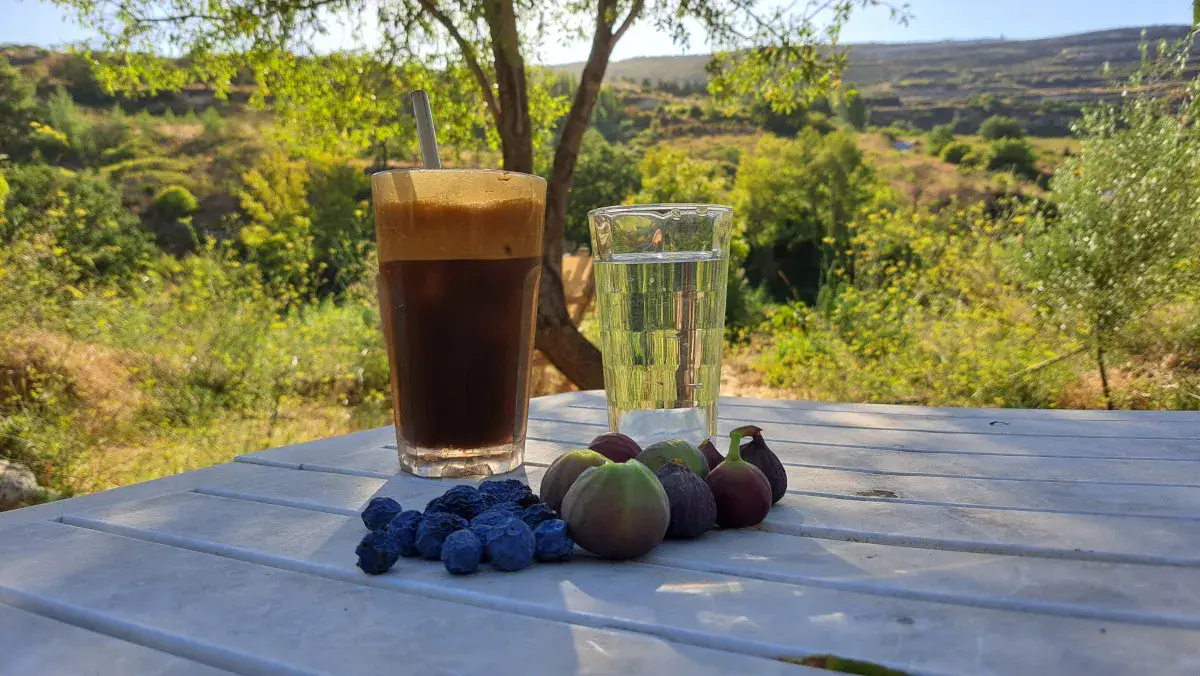
I allow myself the chance to not be productive in the moment, to not check my emails, to not be preoccupied with anything that does not form part of my immediate experience. I slow down on purpose. I choose the pace and thus remain in control of my life. I align myself with nature and, as such, reinforce the alignment that exists within me as one of balance between mind and body.
To some, the café frappé, which by the way is a mark of my irreparable Greekness, is a proxy for negligence and the easygoing life that teeters on irresponsibility. But once you understand who you are dealing with, this symbol of pause is a representation of authority, of structure that is secure in its constitution, of stability throughout.
I have met many Greeks, and Italians for that matter, who feel ashamed about the stereotypes fastened upon the construct of their nationality; stereotypes about the casual life («σιγά-σιγά», literally “slowly-slowly”) and the dolce vita. Yes, the extreme form is undesirable, but knowing how to enjoy life, which is how you pace yourself for the long-term, means that you will be doing it well in the moment and throughout the years.
It is not late to change your defeatist attitude
In a balanced life, vitality will remain your defining feature while those around you will feel depleted. All the Greeks who have internalised racism and thus devalue their culture tell me how “we are old now” even though they are still in their 30s. No, “we” are not in this together, my friend. You may be a dead man walking because you have long now lost sight of beauty, due to your imbalance, but I have not even peaked yet.
Absent the pacing, you quickly turn into a jaded has-been who trades in nothing but name-calling and virtue-signalling. You rely on those to obfuscate the fact that you have been wasting your years in a state of mindlessness, grinding away like an idiot for the benefit of some project you never really liked to begin with.
I remain at your disposal and will be there for you if you choose the right path. Though I stand my ground, even if I have to do it against the rest of the world.
The happy hour empowers me to pursue my interests with a beginner’s enthusiasm and a master’s poise. This is the sportsman within who understands why the sense of agon is a divine matter.
Such is the spirit I embody: a hint of a greater power. It is imposing like the peak of Olympos, pristine as the shallows at Antipaxos, awe-inspiring akin to the Santorini caldera, microcosmic yet inexhaustible just how Cyprus, the island of the goddess of love, reveals itself incrementally only to those who have the requisite playfulness. It is the Mediterranean zest I bring with me as a reminder of what you could have been, had you been paying attention to beauty.