Emacs: add custom entity (Austrian school) to my 'institution-calendar'
My institution-calendar package for Emacs displays term+week
indicators in the *Calendar* buffer (which, by default, is produced
by the calendar command). This is useful, for example, for schools
who organise their work by terms, such as winter, spring, and summer,
with each having a set number of weeks. This is how the University of
Oxford will look like:
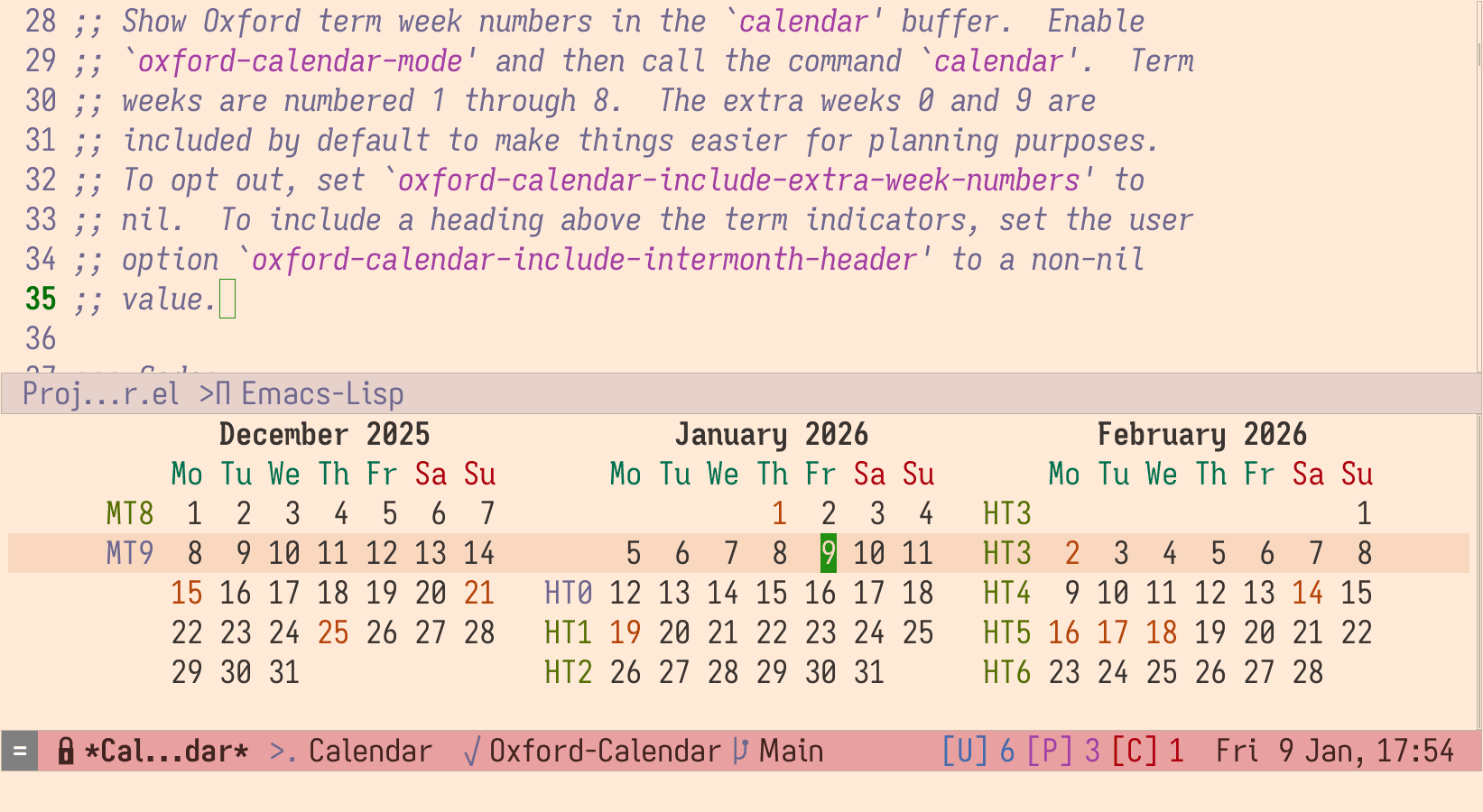
The package supports the universities of Oxford and Cambridge out-of-the-box, though users can define their own institutions. I have two institutions there to provide concrete examples. I am happy to add more, but the idea is for users to maintain their own data.
Below I show a complete example using data for a school in Austria.
Write the calendar data
To make this work, you first need to specify the data. This has the
same structure as institution-calendar-oxford-university-dates and
thus passes the test of institution-calendar-valid-data-p. Look at
the code for Oxford to get an idea. Here is a sample:
(defvar my-austrian-school-dates
  '((2025 (wintersemester ( 9  8 2025) ( 2  6 2026))
          (sommersemester ( 2 16 2026) ( 7 10 2026)))))
This is an Austrian school that has two terms for the academic year
starting in 2025: wintersemester and sommersemester. The symbols
for those terms can be anything. Internally, the package uses the
first letter to form the week indicator, followed by the number of the
week within the given term.
Each term defines a start date and an end date as a list of integers
of the form (MONTH DAY YEAR). I picked a form that is consistent
with the way calendar.el represents the date, otherwise I would have
used a different standard.
Register your institution
The variable institution-calendar-user-entities contains all
user-defined institutions and their corresponding calendar data. Each
entry is a cons cell of the form (ENTITY . CALENDAR-DATA), where
ENTITY is an arbitrary symbol and CALENDAR-DATA is the symbol of a
variable that holds the data, as shown in the previous section.
Here is how we can add to this list:
(add-to-list 'institution-calendar-user-entities (cons 'austrian-school 'my-austrian-school-dates))
In this example, I am calling the newly registered institution
austrian-school, which is how I can refer to it elsewhere. I am
associating this austrian-school with the calendar data of the
variable my-austrian-school-dates.
Make the institution-calendar-mode work for your institution
With the aforementioned in place, the user option institution-calendar-entity
can be set to the value of austrian-school:
(setopt institution-calendar-entity 'austrian-school)
If the institution-calendar-mode is enabled, then the regular
calendar command will display week indicators for this school. This
is good if you only need one calendar. But if you work with many
institutions and thus need to switch between their calendars, then
ignore this step and move to the next one. Or ignore it anyway if you
prefer to keep the M-x calendar intact.
Define a custom command for your institution
The macro institution-calendar-define-convenience-command makes it
trivial to define a command that produces a calendar buffer for the
given institution. This is like M-x calendar with the minor mode
institution-calendar-mode enabled, except it does not alter the
output of the calendar—so you can use them both (or, anyhow, use
as many as the institutions you care about).
;; This defines the command `institution-calendar-austrian-school'.
;; Call `institution-calendar-austrian-school' with M-x or bind it to a key.
(institution-calendar-define-convenience-command austrian-school)
Once you evaluate this macro call, you will get the command
institution-calendar-austrian-school. Use that to produce a calendar
that works with the austrian-school in particular. If you are
curious, M-x institution-calendar-oxford-university will still do
the right thing for the University of Oxford. Same for the command
institution-calendar-cambridge-university.
Use an intermonth header
The user option institution-calendar-include-intermonth-header adds
a header above the week numbers. By default, this only works with the
universities of Oxford and Cambridge. Though you can extend the
package to support your institution by adding to the value of the
variable institution-calendar-intermonth-headers. Thus:
(add-to-list 'institution-calendar-intermonth-headers (cons 'austrian-school "AU"))
You can skip this step if you do not plan to display the intermonth header. Those are not shown by default.
Putting it all together
This is how your configuration of the institution-calendar may look like:
(use-package institution-calendar
  :ensure nil ; not in a package archive
  :init
  ;; Install it from source.
  ;; Then upgrade it with the command `package-vc-upgrade' or `package-vc-upgrade-all'.
  (unless (package-installed-p 'institution-calendar)
    (package-vc-install "https://github.com/protesilaos/institution-calendar.git"))
  :config
  (defvar my-austrian-school-dates
    '((2025 (wintersemester ( 9  8 2025) ( 2  6 2026))
            (sommersemester ( 2 16 2026) ( 7 10 2026)))))

  (add-to-list 'institution-calendar-user-entities (cons 'austrian-school 'my-austrian-school-dates))

  ;; This defines the command `institution-calendar-austrian-school'.
  ;; Call `institution-calendar-austrian-school' with M-x or bind it to a key.
  (institution-calendar-define-convenience-command austrian-school)

  (setopt institution-calendar-include-extra-week-numbers t)
  (setopt institution-calendar-include-intermonth-header nil)

  ;; These are optional, if you want `M-x calendar' to work for your institution.
  (setopt institution-calendar-entity 'austrian-school)

  (institution-calendar-mode 1))
Sources
- Git repository: https://github.com/protesilaos/institution-calendar
- Screenshot: https://protesilaos.com/codelog/2026-02-11-emacs-institution-calendar/
- Backronyms: Interestingly Nothing Serving Teachers Implement Term Utilities Took Inspiration from Oxford Novices… calendar; Institution … Cambridge Added Lent Entry Notwithstanding Dates Already Recorded.